
Introduction
Site list (GPS fixes) Walks (GPS tracks) Video clips Panoramas
Electronic projects:
Bat detector
Lamp tests
µ-controlled lamp
SEPIC-based lamp
ISP isolators
Making SMT boards
Expedition logs:
Spain 1973, 1974,
1975, 1976, 1977,
1979, 1982, 1983,
1985, 1986, 1987,
1988, 1989, 2000,
2001, 2002, 2003,
2004, 2005, 2006,
2007, 2008, 2009,
2010, 2011, 2012,
2013, 2014, 2015,
2016, 2017, 2018,
2019, 2020, 2021,
2022, 2023
Mexico
New England
Translation:
Expedition log, Summer 2005
Rales System, Peña Blanca, Espinosa, Ramales, Durango, etc.
| Date |
Activity |
|---|---|
| 28.07 | Mike is within a minute of missing connection in Paris but makes it (with gear) to Bilbao at 14:30. Bill’s direct flight from Milan is less successful, and he ends up arriving (via Brussels and sans gear) at 21:38, which gives Mike plenty of time to collect the car and explore the nearby coast. Eventually get to hotel in Castro Urdiales around 23:00 then out to hunt for dinner at 23:20. All the restaurants around the port were packed and still serving; Chuletillas went down very well. |
| 29.07 | Hung around Castro for minor shopping, etc., until news noonish that Bill’s bag would be on the 13:43 from Brussels, then drove to BIO (Bilbao Sondika airport) to collect. Huge traffic jams outgoing from and around Bilbao, so at 15:00 cut off the motorways and into the city centre for the first menú del día of the trip. Back on the road at 16:30, and (with a short stop in heavy rain at Ruente) arrived Llanes at 19:30; new hotel (Don Paco »). |
| 30.07 | First objective a cave, of course: Cueva Bolado (near Llanes) for exploration and photos of the modern cave
paintings. 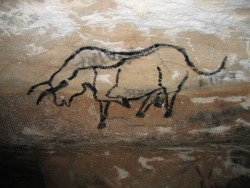 Bolado - modern art Quick visit to Cueva de Caldueñín to take advantage of the exceptionally low water levels this July; in fact there was no running water at all – the main streambed was dry. Usual sump downstream, upstream were only some deep pools easily passable in wetsuits. At 14:15 lunch was served in El Roxin bar at El Mazuco. Chorizo criollo, chuletillas (Mike), lomo (Bill), and Cabrales cheese. Back to the hotel and a walk around town, and dinner at Rte. Covadonga. |
| 31.07 | Purón first; up to El Cuevón de la
Pruneda where we instantly discovered 20m of new inlet passage which
was now obvious as the main stream was dry. Down to the wetter bit
where Bill splashed on almost to the first pitch, needing some wading,
while Mike took advantage of the total darkness to carry out perception
experiments. After the good caving, then walked up to the saddles
above Las Conchas cabañas (750m SE of the cave), finding a series
of interesting but immature speleological features. We turned back
after exploring a depression with a fine old tree, many Hollies,
and a good ‘Mendip dig’ at N43°22'07" W4°42'53".
Back down the hill, and then visited Pedro at La Verde Purón to show him our latest LED lights and exchange news. Next on to Casa Poli, perfectly timing our arrival just before the Sunday lunchtime hordes, for a tapas lunch. More walking around town and an unsuccessful Internet search, followed by dinner at the restaurant on the street above above Las Rocas. |
| 01.08 | Unlocking the door caused our Citreon CS
to partially lose its mind: ‘Christmas tree’ instrument panel. A
Power On Reset (disconnecting the battery) fixed the problem. 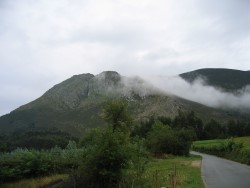 Llabres from the West |
| 02.08 | Nicer weather, so off to Samoreli and Pozo del Molino (above Rales), both nice caves; the duck/crawl at the bottom of the latter showed signs of being dug out, but did not look clear. In contrast the streamway entrance to Samoreli which had been comletely blocked by a tree-trunk in the 1980s was open again. LED lamps (1W headlamps, 3W torches) perfectly adequate even in the large boulder-strewn passage. Sidrería Cabañón in Naves for lunch (fine chuletillas), after which Bill went to Rales to organize a caving trip for Thursday. |
| 03.08 | Even nicer weather, so back to the Purón area and up to Pruneda to investigate the line of depressions due West of the cave (El Brañizu) shown on the map. These were interesting, but nothing big enough for an enterable cave. Lunch at the Sidrería on the road to Purón. Excellent merluza dinner at Terraza in Llanes. |
| 04.08 | 10:30 appointment for caving in Rales.
After waiting for Jorge and family we ascended the track to the Fuentica entrance. Isabel & Leopoldo remained outside, while
the remaining party of 11 entered at about 11:15. María-Carmen and
the youngest child soon exited, as planned, leaving 9 to continue.
The sump area (before the climb) seemed to have been opened up by
floods but yielded no new passage. Enterprising cavers have put a
couple of handlines at key points in the treacherous dry passage
leading to the streamway. Juanjo finds a very tame blind eel, about
20cm long, which Bill photographs in the stream. Nobody seemed keen
on wading in the water to the pitch so we made a steady return to
the entrance without incident for a total trip length of 2 hours.
The younger members of the party were remarkably competent underground
and want to return with us again another year.
We washed in the river and drove to a Sidrería in Mestas for a variety of Fabada based on local green beans, stuffed onions, Cabrales cheese, tortos. After a drink in another bar we returned to Leopoldo and Carmen’s house where we exchanged digital photographs onto CD, including Leopoldo’s from the 1985 trip into Fuentica. Another good dinner at Terraza: escalopines, bonito, Rioja. |
| 05.08 | A prompt start in perfect weather soon
brought us to Carreña de Cabrales and then up to Asiego, where
enquiry at the bar ascertained that the road beyond the village was
passable, though steep and with many precipices – which proved to
be no exaggeration. Bill’s careful driving got us safely to the end
of the road, at Tebrandi 📌, ~780m, where
we started the ascent towards Peña Blanca. A very steep but clear
track took up rapidly up to Collado Virzu (979m) and then due N towards
Peña Blanca into an area of mixed rocks and depressions. Crossing
these, and then bearing slightly west of north, took us up into clean
limestone and then to another pass at Los Virzos, with a truly breathtaking
view west and north to the sea: 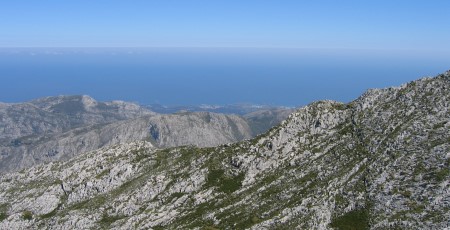 Sea view from Los Virzos From here on there was no real path, and the deep sharp limestone clints and torcas made the going difficult and hazardous. However, we did get to 1130m – within 50m of Peña Blanca – with more stunning views, before being forced to turn back by cliffs. We managed to vary our route in places and explore various speleological possibilities on the way back, making for an excellent walk (500+m of ascent, 3.5 hours). A late lunch in Arenas at the ‘triangular restaurant’ [Restaurante Café Cares] was much appreciated (lomo, chuletillas, huevos, etc.). Later, our dinner plans for Ribadesella were thwarted by it being the evening before the Descent of the Sella » (Fiesta de las Piraguas) – every tiny patch of grass was occupied by a tent, and the town was impenetrable. We escaped along the coast road towards Llanes and soon came across a good fish restaurant, but both found that more meat was called for, after the long walk. |
| 06.08 | Sorted out our caving gear then east to
Suarías and Cabañuca
cave. Usual descent through gorse to fine entrance. Good caving,
but we were again halted by the free climb (as we remembered, but
on 15.08.1988 we used a rope) at the bottom of the
20m pitch – the top of the climb is poor rock and loose boulders
with no good place to belay a handline, which we both felt would
be prudent.
Being in the Deva gorge, we had a fine excuse to visit La Hermida (Rte. Paquin) for the traditional Paella etc. Then up to Bejes: 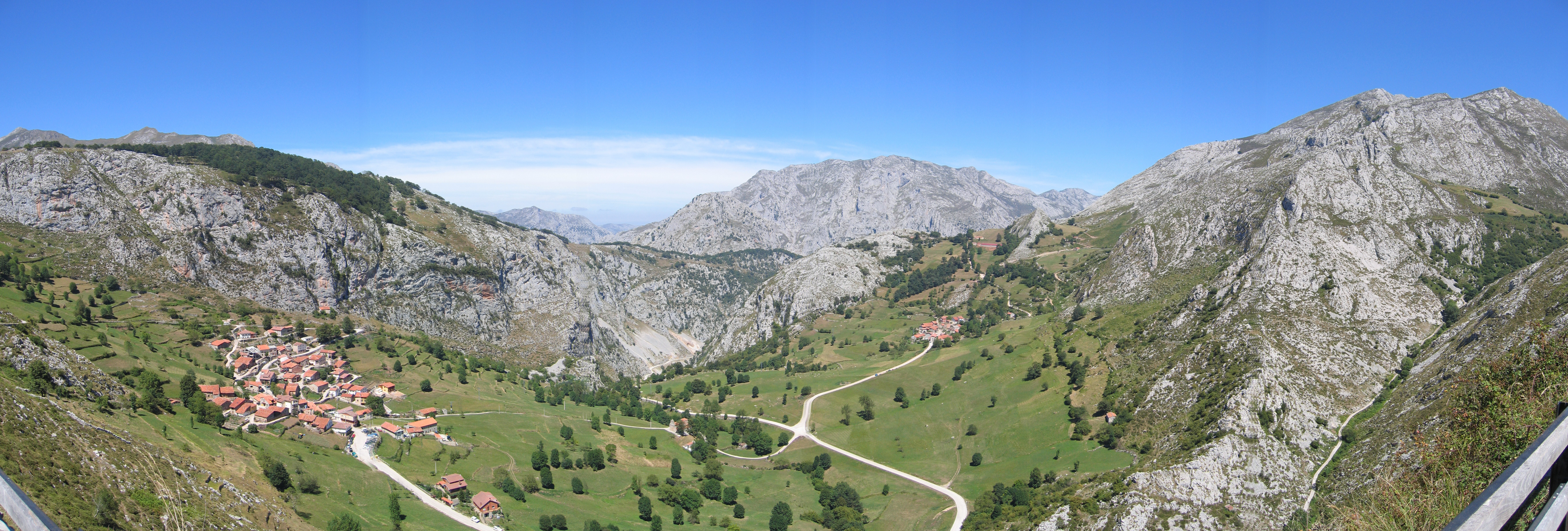 Bejes valley (click for full size) Back to Llanes in time to get what was probably the last free table at Sidrería Cabañón in Naves. |
| 07.08 | Leave Llanes for the return to the East.
We decided on an indirect route passing through Burgos province to
see the karst and cave of Ojo Guareña. A fine streamway sinks in the Sumidero
at the foot of a cliff face. Above in the cliff are numerous caves
including Cueva del Ermita, a show cave (closed for much of the day).
Footpaths led us to the ‘Cueva de las Moscas’, so named by us due
to the large number of winged insects clinging to the walls. It’s
only about 15m long but we did get out of daylight. Above the cliff
is a large shallow Karst depression – plateau might be a better
description – with unusually fractured surface limestone with almost
desert-like flora. One (or more) large shafts penetrate this providing
access to the Ojo Guareña; they are securely fenced off to prevent
anyone falling down.
Continuing to Cornejo we saw an interesting area with caves near the road north of the village, but were too hungry and late to stop – so on to Espinosa de los Monteros » for a fine lunch. Esparragos and “historic” cordero lechal asado (roast suckling lamb) for Mike, paella and solomillo de cerdo for Bill. Then headed north over the Portillo de la Sía (1200m) for a magnificent panoramic view of the Cordillera Cantábrica and beyond to the sea. Continued north to the head of the Asón valley: 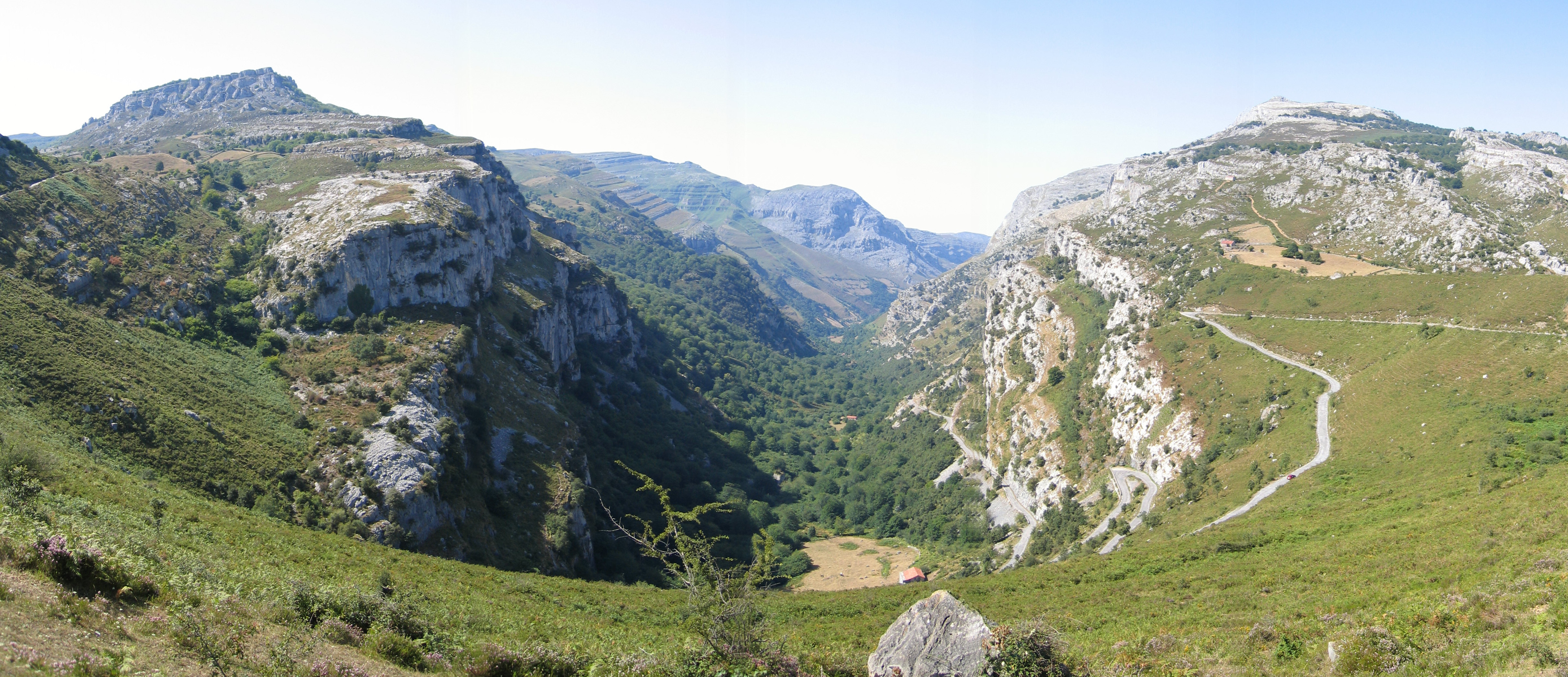 Ason gorge (click for full size) 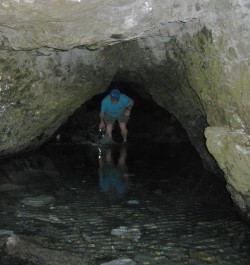 Ason source, Bill wading A slow drive east and then up to San Pedro reveals how little we recall of the Speleogroup camp there in 1977. We explore a possible big resurgence lower down but the mirage turns out to be a substantial rock shelter carved out by a river (now dry). After a beer in Ramales we arrive at Vista Alegre in Castro Urdiales at 20:45 in time to change for a last dinner in the town. However, we only eat a plate of bread and sheep cheese, washed down with Cava. |
| 08.08 |
 Bilbao airport apron After dropping Mike at the airport, Bill drove south to the Parque Natural de Urkiola, south of Durango, which is 30km SE of Bilbao. 4km south of Dima he came across the hamlet of Baltzola and a limestone cliff face containing an easy cave of the same name. A ten minute walk up a track under a natural rock arch leads to the cliff face containing several entrances. The southern part of the valley is sandstone; there is a small stream. The main entrance, some 4m in diameter, presented 3 ways on. Below was the streamway via a free-climbable 2m pitch which presumably exited immediately. To the left was a fossil inlet with easy climbs but requiring access from the streamway. To the right, avoiding the pitch, was a high level passage parallel to the streamway and obviously the main continuation some 4m above the stream. Wearing only a hat and normal clothes the 2m pitch seemed excessive! Taking the path of least resistance the right hand passage was followed and the streamway was soon rejoined in sight of further abandoned sink entrances. These entrances are of such a scale that one remains in sight of daylight throughout the 120m of passage. However the side passages on the left take one out of daylight and it may be that they lead to interesting developments beyond. Some 100m upstream of the top entrances is another short tunnel of 50m leading to a large catchment area in sandstone. In short, fine tourist cave containing at least 250m of walking passage. (A Google search suggests that another tourist cave in the area is Cueva del Jentilkoca de Mugara.) |
| 09.08 | Bill returns to Milan. |
Personnel: Bill Collis & Mike Cowlishaw.
Notes:
- Exchange rate: 1.44; 69.4p = 1 Euro = 166 pesetas (239 pts/GBP).
- Weather: Hot and sunny (27°C–34°C) after 01.08.2005.
- GPS (Garmin Geko 201), positions in °,′,″ shown using WGS84 datum.
- This log was edited in the field on an NEC 780 HPC, using the MemoWiki » extended Wiki notation which is then processed by a Rexx » script to generate the HTML for this web page.